
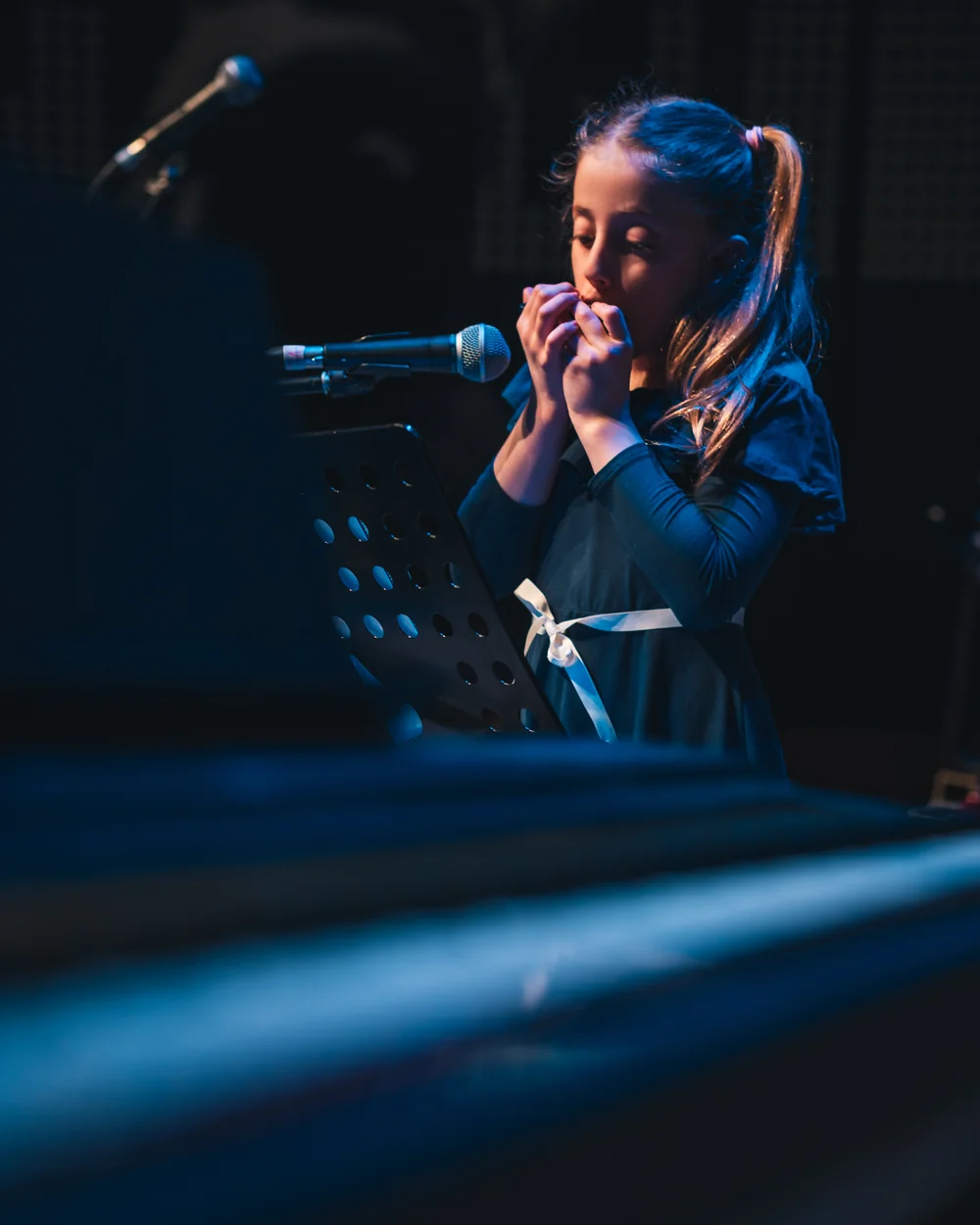
Harmonica Lessons
Older than rock and roll. Played by breath.
Harmonica lessons in Edmonton for all levels. The harmonica was a battlefield instrument before it was a blues instrument, and a blues instrument before it was a rock instrument. It's played by breath alone, where air becomes both the energy and the expression. The basics land in a single session, and the depth keeps unfolding for as long as you stay with it.
Why people come to the harmonica.
Harmonica lessons attract people who want to make music in a different shape than what they already play, and people who want to start with something they can carry and play anywhere. It's one of the few instruments that fits in a hand and goes deep. There's bending notes, breathing through chords, learning to phrase like a singer. The techniques unfold across years. The first session usually ends with the student playing something that sounds like a tune.
Pricing snapshot
Weekly membership includes make-up flexibility with at least one week's notice and one complimentary recording studio hour every three months.
Not sure which fits? See how membership and drop-ins compare.
Harmonica lessons here are taught by Resonate's longest-running teacher.
Mike Chenoweth has been teaching at Resonate since 2013, longer than any other teacher here. He teaches harmonica, guitar, bass, and ukulele, and works as a solo artist alongside teaching. Practicing, performing, and recording fill the weeks around lessons. The blues, country, folk, and roots music he plays is also where the harmonica lives, so lessons tend to come from inside the music itself.
Beginners learn the fundamentals quickly: holding the harp, single notes, breathing, simple melodies. From there, the work moves into bending, chord rhythm, and the kinds of phrasing the instrument's known for. Across the instruments he teaches, Mike comes back to the same idea: serve the song. Lessons stay paced to whoever shows up.
Click the portrait to hear more about how Mike teaches.
Starting is simple
Tell us a little about who lessons are for and what you have in mind.
You do not need everything figured out first.
Going deeper
If you'd like more before reaching out: common questions, the styles you can study, and what tends to develop in your first months and first year. Each section below is collapsed by default. Tap any heading to read more.
Common harmonica questions
Real beginner questions. Tap any to read the full answer.
What harmonica should I buy as a beginner?
For most beginners, a Hohner Special 20 or a Lee Oskar in the key of C, both in the $40 to $60 range, is the standard starter. Suzuki Manji and Hohner Marine Band are also excellent options at similar prices. Avoid the very cheap harmonicas at toy stores and drugstore checkouts; they often have leaky reeds and inconsistent tuning that make it nearly impossible to play single notes cleanly.
Key of C is the right first choice because almost all beginner instructional material is written for C, and most teachers will start you there. After your first few months, you’ll likely want a second harmonica in another key (D and A are common second purchases, since they cover most of what comes up in blues and folk music). Harmonicas in different keys all play the same way; what changes is the pitch.
One important note: harmonicas do wear out. The reeds inside are physical pieces of metal that lose their tuning over time, especially if you bend notes heavily or play hard. A good harmonica played daily lasts about a year of serious practice; played lightly, several years. Replacement is part of the deal, not a sign you bought the wrong one.
Diatonic or chromatic: what’s the difference?
The diatonic harmonica is what most people picture: a small 10-hole harmonica tuned to a single key (usually C for beginners). It’s the standard for blues, folk, country, and rock. Most beginners start here.
The chromatic harmonica has a slide button on the side that shifts the pitch by a semitone. This lets the chromatic play in any key without changing instruments and access notes the diatonic can’t. It’s the standard for jazz and classical harmonica work. Toots Thielemans played chromatic. Stevie Wonder plays chromatic.
For most beginners, diatonic is the right starting point, even if you eventually want to play jazz. The breath control, single-note technique, and the relationship between the player and the instrument all transfer to chromatic later. Starting on chromatic without that foundation is harder than starting on diatonic and learning chromatic afterward.
What gives harmonica that bluesy sound: cross-harp and bending?
Two techniques, both of which are central to harmonica’s blues identity.
Cross-harp (also called second position) is the trick where you play a harmonica tuned to one key in order to play music in a different key. The most common example: playing a C harmonica in the key of G. This sounds strange the first time someone explains it, but it works because of how the diatonic harmonica’s notes line up. Playing in cross-harp puts the bluesy notes (the ones that bend, the ones with vocal-like character) in the right places under your hands. It’s why blues harmonica players carry a different harmonica for each key they want to play in.
Bending is the technique of changing a note’s pitch by adjusting the way you breathe and shape your mouth. It’s how harmonica makes those vocal, crying, expressive sounds. Bending takes time to develop. Most beginners can’t bend at all for the first few weeks. The first bend (usually the 4 draw bend) typically comes within the first month or two of consistent practice. From there, the rest of the bending vocabulary opens up over months and years.
Both techniques are part of every blues harmonica lesson from early on, even when actual blues playing is still some distance away. They’re how the instrument becomes itself.
What’s a good age to start harmonica lessons?
Harmonica is one of the friendliest starting instruments for very young kids. There’s no instrument sizing, no posture problem, no hand-strength requirement. A child can start playing notes the first time they pick one up. Most kids start somewhere between ages 5 and 8.
The catch: the more advanced techniques (bending, cross-harp, clean single notes) require breath control and precise mouth shape, both of which take some focus to develop. The deeper learning typically starts to happen around age 8 or 9. Younger students get a real introduction; the depth comes later.
For kids under 5 who love music but aren’t quite ready for a private lesson, our Tunes & Tots program (ages 2 to 3) and Junior Jammers (ages 4 to 5) build pitch, rhythm, and musical foundation in a group setting.
Adults often ask whether they’re starting too late. They aren’t. Harmonica may be the friendliest adult-starter instrument we teach: it’s pocket-sized, you can practice anywhere, the entry threshold is low, and the connection to music people actually love (blues, folk, songwriting) tends to be direct.
Are online harmonica lessons effective?
In person is generally the better experience, regardless of age. Harmonica is particularly hard to learn online for one specific reason: the sound of bending and tone work is highly sensitive to audio compression. The very things a teacher needs to hear to give useful feedback are the things video-call audio loses first.
That said, harmonica is a more forgiving online instrument than violin or voice for the early stages. Single-note technique, basic blues patterns, and song structure all translate to video reasonably well. The gap shows up most as students start working on tone, bending control, and the more nuanced techniques.
We keep online lessons available because they genuinely serve students who can’t make it in regularly. That includes students who live out of town and come in occasionally for in-person lessons, recitals, or recording sessions. It also covers the weeks when transportation, weather, or feeling a bit under the weather means an in-person make-up isn’t practical.
Plenty of students use a mix of both formats. The quality difference is real, which is why we treat online as a complement to in person rather than a substitute.
How long until I can play a song?
How quickly varies between students, and practice frequency between lessons is the biggest factor. For an engaged beginner practicing a little most days, a simple melody played on single notes is usually playable within the first one or two weeks. By the end of the first month, simple folk and country melodies are within reach.
Blues takes longer. The bluesy sound that draws most adults to harmonica depends on cross-harp positioning and at least some basic bending, which typically takes one to three months of consistent practice to start sounding right. By six months, most students with consistent practice are playing recognizable blues riffs and the beginnings of improvised lines over a 12-bar blues.
What “playing a song” means varies. Hitting the right notes in the right order is one threshold, often crossed within the first month. Playing with the rhythm and feel of the original is another, typically a few months later. Adding bending, vibrato, and personal expression is the next layer.
Styles you can study at Resonate
Harmonica lessons here can move across a wide range of musical territory. Tap any style to read more.
Blues
The deepest tradition for harmonica. Little Walter, Sonny Boy Williamson I and II, James Cotton, Big Walter Horton, Howlin’ Wolf, more recently James Harman and Kim Wilson. Cross-harp playing, bending vocabulary, the 12-bar form, and the kind of vocal expression that made harmonica the second voice of Chicago blues. Most adult harmonica students arrive wanting to play blues, and this is where the depth lives.
Folk and singer-songwriter
The harmonica-and-guitar tradition with the neck harness. Bob Dylan, Neil Young, Bruce Springsteen, the broader folk tradition where harmonica fills the spaces between vocal lines. Often paired with guitar in lessons for students who want to accompany themselves.
Country and Americana
Country harmonica has its own vocabulary distinct from blues. Charlie McCoy is the defining reference. Tighter, more melodic playing, less bending, more articulation. A natural fit for students drawn to country and Americana songwriting.
Rock and pop
John Lennon’s Beatles work, Mick Jagger’s Rolling Stones playing, Stevie Wonder’s chromatic playing across pop and R&B (Stevie plays chromatic, not diatonic). Useful for students wanting harmonica as a featured part of contemporary band music.
Jazz and chromatic
Where the chromatic harmonica lives. Toots Thielemans is the standard reference. Bebop heads, ballads, harmonically sophisticated improvisation, and the kind of melodic playing that fits in a jazz combo. A demanding tradition that requires switching instruments from diatonic to chromatic.
Theory and improvisation layered in
For students wanting to understand how music works beyond memorizing licks: how positions other than cross-harp work (third position, fifth position), chord function, scales, and improvising over chord changes. Especially valuable for students moving from blues into jazz, or wanting to play harmonica in styles outside the typical blues and folk territory.
What to expect in your first months and first year
Rough averages. Pace varies based on age, practice consistency, and any prior musical experience.
Your first lesson
How to hold the harmonica, how to draw and blow on single holes (versus producing chords across multiple holes at once), basic breath control, and your first simple melody on adjacent holes. The visible progress varies; what’s actually beginning is the way your mouth shapes around the holes, your breath control, and the relationship between tongue, lips, and instrument.
Your first month
With consistent practice, which is the single biggest variable in how quickly anyone progresses, most beginners are playing clean single notes most of the time by the end of the first month and can get through simple melodies (folk and country songs are common starting material) without buzzing or hitting unintended adjacent notes. Breath control starts to settle. What’s developing in this period is the precision of mouth shape and the early intuition for where notes live on the harmonica. The visible progress can feel slow even when the underlying foundation is building.
Your first three months
By around three months, most students have a small collection of melodies and the beginnings of cross-harp playing, which is what makes the instrument sound like itself. The first bend (usually on draw 4) often arrives in this window. Practice begins to feel less like effort. Weekly membership students reach their first complimentary recording studio session around this point, which can become a low-pressure way to capture something they’ve been working on.
Your first year
The difference between students widens here. Those who practice regularly typically have a meaningful blues vocabulary, clean bending on multiple draw notes (and the beginnings of blow bends on higher holes), growing comfort improvising over a 12-bar blues, and the rhythmic feel that connects harmonica to its source traditions. Less consistent students may still be building basic single-note cleanliness, and that’s fine too. Through the year, opportunities to perform in Resonate recitals and to use the included recording studio sessions come up several times for students who want to take them. Harmonica players often find themselves invited into other students’ sessions and jams because the instrument fits easily into so many styles.
Beyond the first year
Harmonica is a lifelong instrument. The teachers here have been playing for decades and still find new things in it. The first year is about getting the foundational pieces down: clean single notes, comfortable breath control, basic cross-harp playing, the beginnings of bending. What comes after is leveling up what you can do with those foundations: the licks and lines you can play, the bands you can join, the recording sessions you can carry, the depth of expression you can pull out of a small piece of metal and wood.
Some students stay primarily in blues and go deep into the tradition. Some move into folk, country, or songwriter accompaniment. Some pursue chromatic for jazz. Some teach. Many do some combination of these over time.
Most students who stay with harmonica stay in lessons for years, because there is always another layer to add: another lick, more refined bending, deeper improvisation, more nuanced tone. The road forks based on what lights you up, and a good teacher helps you notice which fork is calling.