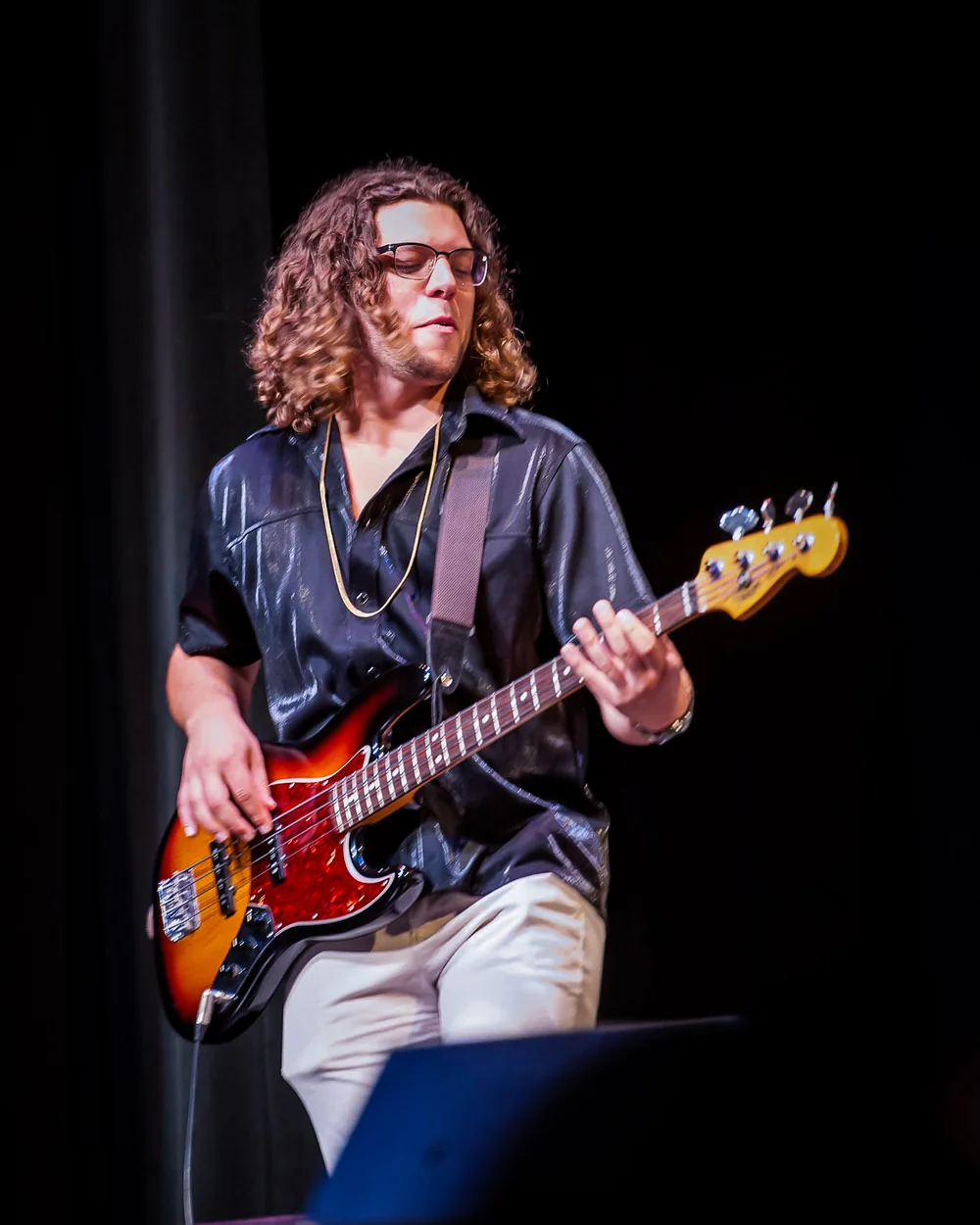
Bassist playing a semi-hollow electric bass during a performance at Resonate in Edmonton

Bass Lessons

Bass lives in the pocket.

Pocket is a bass player's word for the rhythmic feel where bass and drums lock together and the rest of the band sits on top. People feel it before they think about it, and most of what makes a song land is the pocket holding.

Bass is the thing you notice most in its absence.

Take bass out of a song and what's left feels thinner. Less weight, less space, less of the low frequency that travels through floors and into the chest. Bass works on the listener's body before the mind catches up. Most people don't notice how much it's doing until it isn't there, and most musicians don't realize how much there is to it until they start playing it themselves.

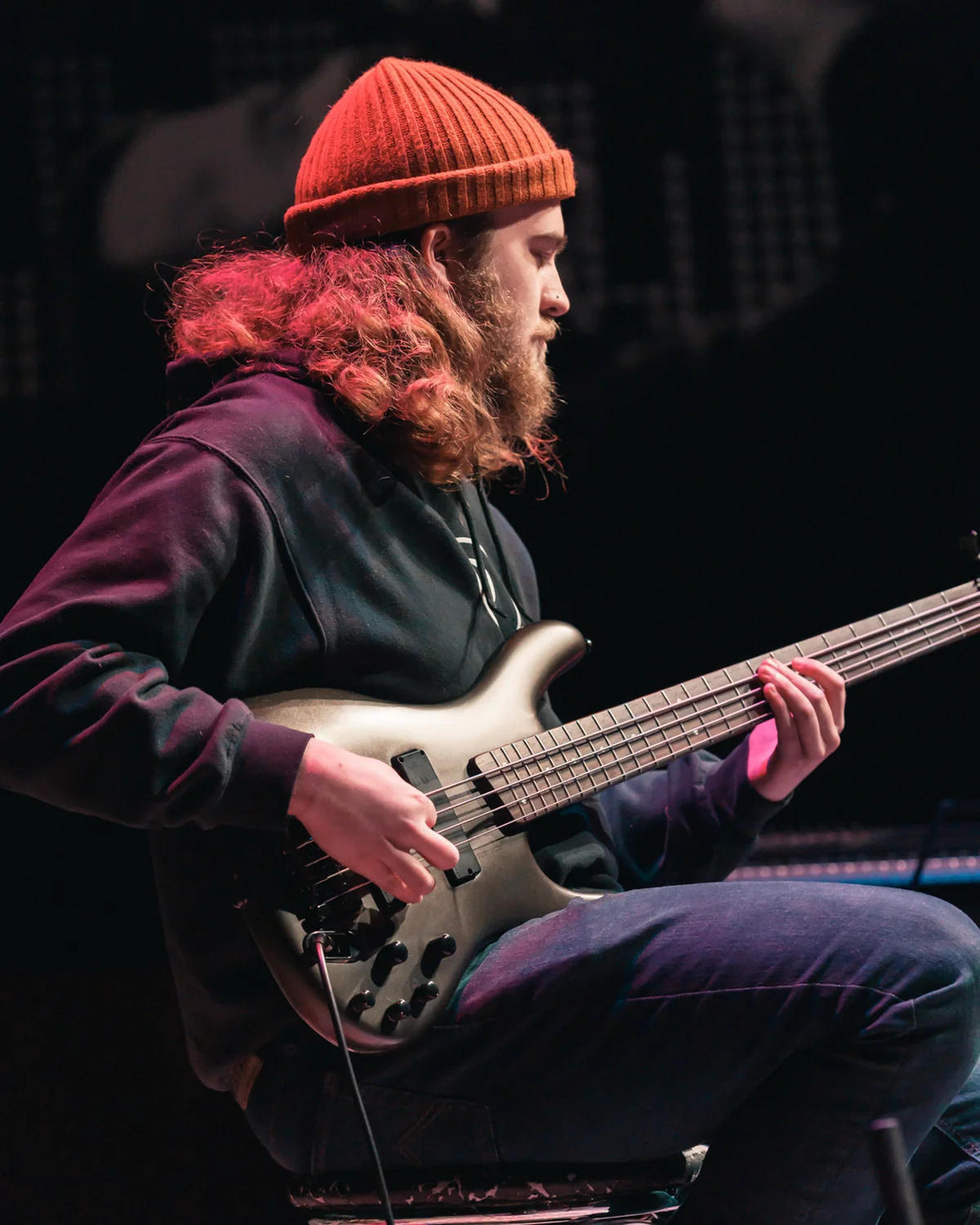
Bassist playing a six-string bass during a performance at Resonate in Edmonton

How bass learning tends to unfold here

Most of what makes a bass line lock in happens in the time, the touch, and the choice of what to leave out.

01

Right hand and left hand, the foundation everything else sits on

The right hand is where the bass actually meets the song. Fingerstyle, pick, slap, palm muting. Each has its own touch and timing, and switching between them changes what the song feels like. We spend real time on these because they're not just preparation for the music. They are the music.

02

Time and feel as the actual subject matter

Most of what bass lessons work on is when notes happen, not what notes are played. Sitting just behind the beat, just in front, or right in the middle. We work with metronome first, then recordings, then the drummers students eventually play with. That's where pocket actually lives.

03

Hearing the bass changes how you hear everything

Once you start playing bass, you stop hearing songs the way you used to. The bass line is suddenly the most interesting part of every record you already know. Lessons spend real time on those records, hearing what the bass is doing and how it shapes the song. The songs students bring in are the curriculum.

Bass student seated on a stool playing a teal short-scale bass on the Resonate stage in Edmonton

A good fit often looks like this.

Bass tends to fit people who like making music with other people more than they like being the focal point. Bandmates, jam sessions, the rhythm section. It's also the instrument musicians come to when they want to round out how they hear and play.

That might mean a beginner who already wants to be in a band, a guitarist or pianist looking to add bass as a second instrument, a returning player who hasn't picked it up in a decade, or someone who's been playing along to records at home and wants to find out what's actually under their fingers. Bands are usually looking for bass players, and a bassist who can hold a pocket tends to stay busy. The path opens up differently for each, but the core work is the same: feel, listening, time.

Practical lesson options

Private bass lessons are available through weekly membership or as drop-ins.

30 minute private lesson

Often a strong fit for younger beginners, or for people who want a consistent weekly starting point.

60 minute private lesson

A better fit for older students, adults, returning players, or anyone who benefits from more room to settle in and work through ideas.

Weekly membership

The primary lesson structure at Resonate. It includes a reserved weekly lesson time, make-up lesson flexibility, and one complimentary recording studio hour every three months.

Drop-ins

A flexible option for students who do not want a fixed weekly time. These are single lessons booked individually based on teacher and schedule availability.

Pricing snapshot

01
30 minute lesson – drop-in
$40
02
30 minute lesson – weekly membership Lessons on Mondays are $135/mo to account for long weekends
$145/mo
03
60 minute lesson – drop-in
$75
04
60 minute lesson – weekly membership Lessons on Mondays are $265/mo to account for long weekends
$285/mo

Weekly membership includes make-up flexibility with at least one week's notice and one complimentary recording studio hour every three months.

Lessons here are shaped by real teachers.

Six bass teachers work at Resonate. They each came to bass through a different door: band life, studio sessions, jazz, a switch from another instrument. That breadth matters because bass means different things in different musical contexts, and the right teacher tends to be the one whose musical world overlaps with the student's.

In a one-to-one lesson, what the teacher knows shapes what the student gets. A bass teacher who has spent a decade in working bands knows different things than one who has spent it in the studio, and both know things a method book cannot tell you. The lesson room is the place those different ways of knowing actually come through.

Click a portrait to hear more about how they teach.

Starting is simple

Tell us a little about who lessons are for and what you have in mind.
You do not need everything figured out first.

Start Here

Going deeper

If you'd like more before reaching out: common questions, the styles you can study, and what tends to develop in your first months and first year. Each section below is collapsed by default. Tap any heading to read more.

Common bass questions

Real beginner questions. Tap any to read the full answer.

What bass should I buy as a beginner?

For most adult beginners, a basic 4-string electric bass in the $250 to $500 range is more than enough. Squier (the budget arm of Fender), Ibanez, and Yamaha all make starter basses that play cleanly out of the box. Avoid the very cheapest basses at big-box stores; they often have setup and fretwork issues that make learning harder than it needs to be. Myhre’s Music in Edmonton stocks starter basses that are properly set up, and we’ve been referring families there for years.

For kids and smaller adults, a short-scale bass (30-inch scale instead of the standard 34-inch) is significantly easier to fret. The Squier Mini-P and the Ibanez Mikro are common entry points for younger students. A short-scale bass is also a perfectly legitimate long-term instrument; many professional bassists play short-scale by choice.

For amps, see the next FAQ. A bass with no amp is essentially a quiet acoustic that’s hard to hear, so the two purchases tend to come together.

4-string, 5-string, or 6-string?

For most beginners, 4-string is the right starting point. The 4-string covers nearly all rock, pop, blues, country, folk, reggae, and most jazz. The string count is consistent with what most teaching material assumes, and the neck is the right width for hand development.

A 5-string adds a low B string, which gives you access to lower notes used in some contemporary music (heavier rock, metal, modern worship, some R&B, and a lot of music written in lower keys for modern singers). The wider neck takes some adjustment. Many bassists eventually own both, picking whichever suits the gig.

A 6-string adds a high C string and is a more specialized instrument, primarily used in jazz, fusion, and progressive styles for melodic and chordal playing. Most beginners don’t need to think about 6-string unless they’re specifically drawn to those styles.

The honest answer is that 4-string is the default starting point and a perfectly complete instrument for a long musical life. The other counts are tools for specific situations.

Do I need an amp at home, or can I practice quietly?

You need a way to hear the bass clearly, but you have options. A small practice amp (the Fender Rumble 25 or 40, the Ampeg BA-108, and similar in the $150 to $300 range) is the most common starting point and is plenty for home practice. A headphone amp (the Vox amPlug Bass and similar plug-into-the-bass devices in the $30 to $60 range) is silent to the outside world and works well for late-night practice, hotel rooms, and shared living situations.

You can also run a bass directly into a computer interface and practice with headphones through software (GarageBand, Reaper, others), which is how a lot of bassists practice during recording-heavy weeks. Whatever the setup, the key is being able to hear yourself clearly enough to hear what you’re actually doing. A bass that sits silent on a stand doesn’t develop the way one you’re actually playing through does.

What’s a good age to start bass lessons?

Most students start private bass lessons between ages 8 and 10. Bass is slightly older as a starting instrument than guitar because the scale length (the distance between frets) is longer, which means more hand stretch. Younger kids can absolutely start on bass if they’re physically ready, especially on a short-scale bass that’s sized appropriately. A teacher can usually tell within the first lesson whether the hand reach is comfortable or whether a smaller instrument would serve better.

For kids under 8 who love music and want to head toward bass, starting on a smaller instrument (ukulele is a common gateway, sometimes guitar) and switching to bass when their hands are ready is a perfectly reasonable path. Many bassists started on guitar.

For kids under 6 who love music but aren’t quite ready for a private string instrument, our Tunes & Tots program (ages 2 to 3) and Junior Jammers (ages 4 to 5) build rhythm and musical foundation in a group setting.

Adults often ask whether they’re starting too late. They aren’t. Bass tends to reward adult students particularly well: a clearer sense of what music moves you, the patience to work on something less flashy than lead guitar, and a willingness to listen carefully to what’s happening around the bass line.

Are online bass lessons effective?

In person is generally the better experience, regardless of age. Hand position, fretting cleanly, plucking technique, and the way the body moves through a bass line are all easier for a teacher to see and correct in the same room. The audio quality difference also matters more on bass than on most instruments, since the low frequencies of bass are the first thing compressed audio loses.

We keep online lessons available because they genuinely serve students who can’t make it in regularly. That includes students who live out of town and come in occasionally for in-person lessons, recitals, or recording sessions. It also covers the weeks when transportation, weather, or feeling a bit under the weather means an in-person make-up isn’t practical.

Plenty of students use a mix of both formats. The quality difference is real, and we noticed it directly during the COVID period when everything was online. That’s part of why we treat online as a complement to in person rather than a substitute.

How long until I can play with a band?

How quickly varies between students, and practice frequency between lessons is the biggest factor. For an engaged beginner practicing a little most days, simple repeated bass lines under a familiar song are usually playable within the first few weeks, and a full song held end-to-end is often within reach by the end of the first month or two. Playing with other people, a drummer in particular, is a slightly different skill that develops alongside, and most students are ready to try a jam after two or three months of consistent practice.

What “playing with a band” means varies. Holding the root note through a song so the harmony makes sense is one threshold. Locking in with the drummer so the rhythm section feels like one thing is another. Playing the actual recorded bass line in the song is a third. Most students cross the first threshold within their first few months. Bass is one of the instruments where playing with other people happens earlier than students expect, because every band needs a bassist.

Styles you can study at Resonate

Bass lessons here can move across a wide range of musical territory. Tap any style to read more.

Rock and pop

The most common starting point. Root-note bass lines, octave patterns, pedal tones, and the supporting role bass plays in most contemporary songs. Lessons build around the songs that pulled you toward bass in the first place, and the underlying patterns transfer easily into nearly every other style.

Funk, soul, and R&B

The deepest tradition for bass as a foreground instrument. Sixteenth-note patterns, syncopation, ghost notes, the conversation between bass and drums, and slap bass technique for students drawn to that sound (Larry Graham, Marcus Miller, Bootsy Collins). From classic Motown through contemporary R&B and neo-soul. Useful as a primary path for students who want bass to move, and as a foundation that sharpens everything else.

Jazz and walking bass

A full tradition with its own vocabulary: walking through chord changes a quarter note at a time, comping with rhythm, soloing over chord progressions, ear training, and the practice of holding the harmony for a whole band. Builds reading fluency and chord knowledge in ways most other styles don’t demand. Useful as a primary path for students drawn to jazz, and as a foundation layer that makes a bassist hireable in nearly any setting.

Reggae, dub, and Motown

Heavily bass-driven styles where the bass line is often the most identifiable part of the song. Off-beat patterns, deep pocket, space and silence as part of the line, and a sense of feel that’s distinct from rock and pop. Often paired with funk study, since the techniques overlap.

Latin and Afro-Cuban

Bossa, samba, salsa, and the rhythmic vocabulary that crosses into much of contemporary music. The clave is the foundation. Latin bass tends to live in a different relationship to the beat than rock or jazz, which is part of what makes it worth studying as a way of opening up your overall feel.

Theory and reading layered in

For students wanting to understand how music actually works beyond memorizing bass lines: chord function, scales, ear training, basic notation, and the kind of theory background that makes a bassist genuinely useful in a session where someone hands you a chord chart. Rarely required and never forced, but available as a layer running through any other style. Especially valuable for students aiming at jazz, session work, or playing with other musicians regularly.

What to expect in your first months and first year

Rough averages. Pace varies based on age, practice consistency, and any prior musical experience.

Your first lesson

Most first lessons cover how to hold the bass (seated typically for the first few, sometimes standing with a strap), finger numbering, posture, your first plucked notes, and either a first simple bass line or your first scale, depending on what your teacher starts you on. A bit of take-home practice to begin the muscle memory. The visible progress varies; what’s actually beginning is the relationship between the left hand (fretting) and the right hand (plucking), and the development of finger calluses on the fretting hand. Most beginners experience some finger tenderness in the first couple of weeks before the calluses develop.

Your first month

With consistent practice, which is the single biggest variable in how quickly anyone progresses, most beginners are playing simple repeated bass lines under a song they recognize by the end of the first month. Often something with a steady root-note pattern or a basic walking line. Some students get there sooner. Others take longer, especially if practice between lessons is irregular. What’s developing in this period is hand strength, the muscle memory of fret positions, the basic coordination between plucking and fretting, and the practice habit itself. The visible progress can feel slow even when the underlying foundation is building.

Your first three months

By around three months, most students have a small collection of bass lines they can play through cleanly, growing comfort moving around the neck (within the first five frets at least), and the beginnings of being able to learn new lines either by ear or from a chord chart. Practice begins to feel less like effort. For some students this is the turning point where bass starts to feel like something they actually play rather than something they’re learning. Weekly membership students reach their first complimentary recording studio session around this point, which can become a low-pressure way to capture something they’ve been working on.

Your first year

The difference between students widens here. Those who practice regularly typically have a meaningful catalogue of bass lines they enjoy playing, growing comfort across the whole neck, the beginnings of being able to play with other people reliably, and the rhythm-section instinct of locking in with whatever drums are happening alongside them. Less consistent students may still be building basic fluency, and that’s fine too. Through the year, opportunities to perform in Resonate recitals and to use the included recording studio sessions come up several times for students who want to take them. Bass players often end up in band situations earlier than students of other instruments because every band needs a bassist, and a steady one is harder to find than people realize.

Beyond the first year

Bass is a lifelong instrument. The teachers here have been playing for decades and still find new things in it. The first year is about getting the foundational pieces down: clean fretting, steady plucking, basic coordination, comfort with the supporting role of the instrument. What comes after is leveling up what you can do with those foundations: the styles you can play, the bands you can join, the recording sessions you can take on, the chord changes you can navigate without sheet music.

Some students build deep facility across multiple styles. Some focus on funk or jazz and go deep. Some end up doing session work or joining touring bands. Some shift into composition or production. Some teach. Many do some combination of these over time.

Most students who stay with bass stay in lessons for years, because there is always another layer to add: another style, more refined feel, deeper understanding of how rhythm sections work, more comfortable reading. The road forks based on what lights you up, and a good teacher helps you notice which fork is calling.