
Mandolin Lessons
Bright strings, fast hands.
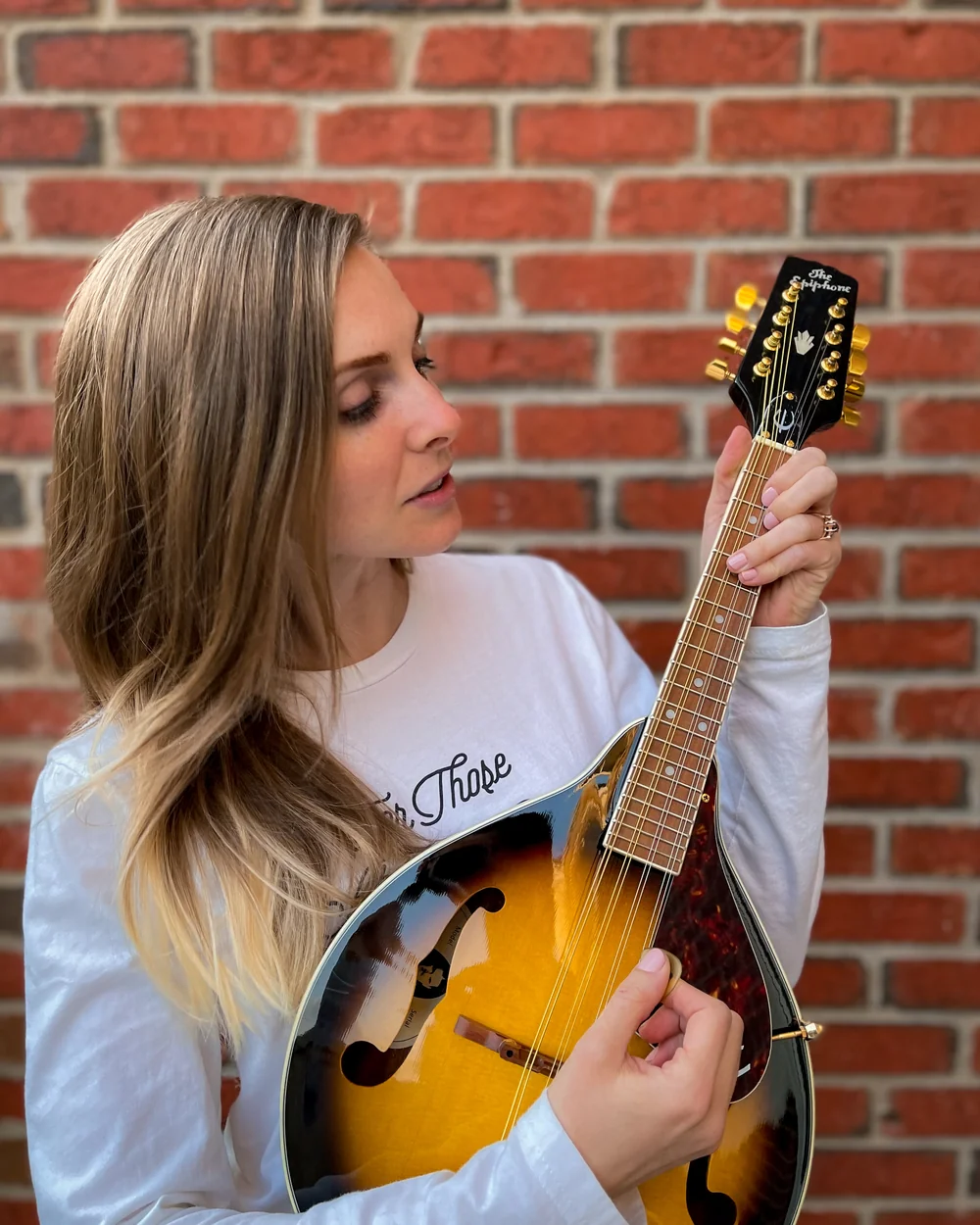
Mandolin lessons in Edmonton for guitarists, fiddle players, and folk and bluegrass musicians. The mandolin is a small instrument with a big voice. Eight strings tuned in pairs, a short fretboard, and a way of carrying both melody and rhythm in the same line.
Why people come to the mandolin.
Most mandolin students at Resonate already play something else. Guitarists drawn to the higher register and the tremolo. Violinists curious about a fretted cousin. Players deep in folk, bluegrass, country, or acoustic singer-songwriter worlds where the mandolin sits in the mix and adds bright detail. The chord shapes are different from guitar and the right-hand technique takes time, but the basics land quickly because most of what's transferring is musical instinct, not motor skill from scratch.
Pricing snapshot
Weekly membership includes make-up flexibility with at least one week's notice and one complimentary recording studio hour every three months.
Not sure which fits? See how membership and drop-ins compare.
Lessons here are shaped by real teachers.
Two mandolin teachers work at Resonate, and they come to the instrument from different directions. One came up through folk and roots traditions, where the mandolin has always lived. The other is a songwriter and multi-instrumentalist who plays it alongside guitar, piano, and banjo. Between them, a student can find the mandolin that fits the music they already care about.
In a one-to-one lesson, the guidance shapes itself around the player. Newer students learn the chord shapes, the tremolo, and the way the mandolin sits inside a song. Students with more experience move into the deeper repertoire, the cross-picking, and the lead playing the instrument is known for. A teacher can watch what is starting to click, what is not yet settling, and what to put in front of the person next.
Click a portrait to hear more about how they teach.
Starting is simple
Tell us a little about who lessons are for and what you have in mind.
You do not need everything figured out first.
Going deeper
If you'd like more before reaching out: common questions, the styles you can study, and what tends to develop in your first months and first year. Each section below is collapsed by default. Tap any heading to read more.
Common mandolin questions
Real beginner questions. Tap any to read the full answer.
What mandolin should I buy as a beginner?
For most beginners, a basic mandolin in the $200 to $500 range is plenty to start. Kentucky, The Loar, and Eastman all make solid entry-level mandolins that play cleanly out of the box. The very cheapest mandolins online tend to have setup problems (action too high, intonation off, weak factory strings) that make learning harder than it needs to be.
Myhre’s Music in Edmonton can point you toward a properly set-up starter mandolin, and they handle rentals as well, which is often the right path for an adult who isn’t yet sure mandolin will stick.
Higher-tier mandolins run further up. A solid-top mandolin in the $700 to $1500 range opens up significantly more tone and projection, and serious players move into the $2000+ range for hand-built instruments from makers like Collings or Weber. Those are upgrades you might make after a year or two of committed playing, not first purchases.
A-style or F-style: what’s the difference?
Mandolins come in two main body shapes:
- A-style: the simpler teardrop body with no decorative scroll. Lighter, less expensive, and the practical choice for most beginners. Sounds excellent and is the body shape used by many serious players (Chris Thile played an A-style for years).
- F-style: the iconic body shape with the curled scroll on the upper bout, traditionally associated with bluegrass. More expensive to build, often considered the visual standard for the genre, and the tone tends toward a slightly brighter, more cutting sound that projects in a bluegrass band setting.
Both shapes can sound wonderful or terrible depending on build quality. A well-made A-style will outplay a poorly-made F-style every time. For a first instrument, an A-style in the $200 to $500 range will serve you better than an F-style at the same price, because more of the build budget went into the wood and craftsmanship and less into the shape.
The honest answer: at the beginner level, A-style is the practical pick. If you fall in love with mandolin and want to upgrade later, F-style might be where you land.
I play guitar (or violin). How much carries over to mandolin?
A lot, depending on which instrument.
If you play guitar, the fretted left hand will feel familiar, although mandolin frets are tighter and chord shapes are completely different. There are no chord shapes you already know from guitar that transfer. Picking with a flat pick also carries over directly. What’s genuinely new: 8 strings in 4 courses (paired strings tuned to the same note), the much higher string tension, and a tuning that doesn’t match guitar at all (mandolin tunes GDAE, same as violin).
If you play violin or fiddle, the tuning carries over directly. Every note you know on the violin lives in the same place on the mandolin. What’s genuinely new: frets, the use of a pick rather than a bow, and a different relationship between the two hands. But the mental map of the fingerboard is already there, which gives violinists a real head start.
If you play neither, that’s fine. Mandolin is friendly enough as a first fretted string instrument, particularly for students drawn to bluegrass or Celtic music. The pairings between mandolin and other string instruments are a meaningful bonus, not a requirement.
What’s a good age to start mandolin lessons?
Most students start mandolin between ages 8 and 12, though kids as young as 6 or 7 can start on a smaller-bodied mandolin if their interest is strong and their hands can manage the reach. Mandolin frets are tight and the string tension is real, so very young hands work harder than they do on a ukulele.
For kids under 8 who love folk or bluegrass music, ukulele or violin make natural earlier-instrument paths that connect smoothly to mandolin later. Either one builds skills that transfer directly.
For kids under 6 who love music but aren’t quite ready for a private string instrument, our Tunes & Tots program (ages 2 to 3) and Junior Jammers (ages 4 to 5) build pitch, rhythm, and musical foundation in a group setting.
Adults often ask whether they’re starting too late. They aren’t. Mandolin tends to reward adult students particularly well: it’s small, friendly to carry around, the bluegrass and Celtic communities are welcoming to beginners, and most adults find an instrument-pairing dimension to mandolin that adds depth to whatever else they’re playing.
Are online mandolin lessons effective?
In person is generally the better experience, regardless of age. Pick technique, left-hand position on the tight fretboard, the angle of the pick across two strings of the same course at once, and the small physical adjustments that build cleaner playing are all easier for a teacher to see in the same room.
We keep online lessons available because they genuinely serve students who can’t make it in regularly. That includes students who live out of town and come in occasionally for in-person lessons, recitals, or recording sessions. It also covers the weeks when transportation, weather, or feeling a bit under the weather means an in-person make-up isn’t practical.
Plenty of students use a mix of both formats. The quality difference is real, which is why we treat online as a complement to in person rather than a substitute.
How long until I can play a tune?
How quickly varies between students, and practice frequency between lessons is the biggest factor. For an engaged beginner practicing a little most days, a simple tune (something like “Boil Them Cabbage Down” or a slow jig) is usually playable within the first few weeks, and a complete tune played cleanly is often within reach by the end of the first month or two.
What “playing a tune” means varies. Getting through the melody at a slow tempo is one threshold, often crossed in the first few weeks. Playing it cleanly at the standard tempo is another, typically a few months later. Adding double-stops, ornaments, and the rhythmic drive that makes a tune sound like itself is the next layer. Most students cross the first threshold within their first month or two of consistent practice.
Styles you can study at Resonate
Mandolin lessons here can move across a wide range of musical territory. Tap any style to read more.
Bluegrass
The deepest tradition for mandolin. Bill Monroe (who basically invented the genre as we know it), David Grisman, Sam Bush, Chris Thile, Sierra Hull. Driving rhythm chops, blistering melodic playing, twin-mandolin harmonies, and the band format mandolin was built for. Reading is rare in this world; learning happens by ear and through tunes and licks shared between players.
Celtic and folk
Irish jigs, reels, hornpipes, and the broader Celtic tune tradition. Scottish tunes, Cape Breton material. A natural fit for mandolin’s high range and quick articulation, and a tradition with a strong jam culture where beginners can find their way in early.
Old-time and Americana
Pre-bluegrass American string-band music. Fiddle tunes adapted to mandolin, old country, gospel-adjacent material, and the kind of repertoire that overlaps with what a fiddler or banjo player might be working on. Often a natural extension for students who started in bluegrass or folk.
Classical
The mandolin has a real classical tradition, particularly from the Italian Baroque and 19th-century European composers (Vivaldi and Beethoven both wrote for it). Less commonly played now than the folk traditions, but a beautiful path for students drawn to written, technique-focused music.
Songwriting and contemporary
Mandolin as a texture in contemporary singer-songwriter, indie, and folk-rock contexts. Nickel Creek, the Punch Brothers, Mumford & Sons, contemporary Americana. Often paired with voice and guitar in lessons.
Theory and reading layered in
For students wanting to understand how music works beyond memorizing tunes: chord function, scales, key signatures, ear training, basic notation. Especially useful for classical study and for students wanting to write or arrange music.
What to expect in your first months and first year
Rough averages. Pace varies based on age, practice consistency, and any prior musical experience.
Your first lesson
How to hold the mandolin (against the body, supported by the right forearm), how to hold the pick (which feels strange at first for everyone), basic left-hand finger placement, your first open-string picking exercise, and maybe a first simple melody on one string. The visible progress varies; what’s actually beginning is left-hand strength, pick control, and the development of fingertip calluses. Mandolin strings are steel and the tension is high, so finger tenderness in the first couple of weeks is normal before calluses develop.
Your first month
With consistent practice, which is the single biggest variable in how quickly anyone progresses, most beginners are playing simple tunes on one or two strings by the end of the first month. Picking accuracy starts to settle. The left-hand fingertips toughen up. Basic chord shapes (the bluegrass chop chord, simple two-finger shapes) start to feel less awkward. What’s developing in this period is pick control, left-hand finger placement, and the practice habit. The visible progress can feel slow even when the underlying foundation is building.
Your first three months
By around three months, most students have a small collection of simple tunes they can play through cleanly, growing comfort with the basic chord shapes, and the beginnings of being able to learn new tunes by ear or from notation. Practice begins to feel less like effort. Weekly membership students reach their first complimentary recording studio session around this point, which can become a low-pressure way to capture something they’ve been working on.
Your first year
The difference between students widens here. Those who practice regularly typically have a meaningful catalogue of tunes they can play, comfort with chord chops and basic melodic playing, the beginnings of double-stops and simple ornaments, and the rhythmic feel that connects mandolin to the broader fiddle-and-strings tradition. Less consistent students may still be building basic fluency, and that’s fine too. Through the year, opportunities to perform in Resonate recitals and to use the included recording studio sessions come up several times for students who want to take them. Mandolin students who play with other string players (fiddlers, guitarists, bassists) often find jam sessions earlier than students of more solo instruments because mandolin lives in the band.
Beyond the first year
Mandolin is a lifelong instrument. The teachers here have been playing for decades and still find new things in it. The first year is about getting the foundational pieces down: clean picking, basic chord chops, simple tunes, fingertip toughness. What comes after is leveling up what you can do with those foundations: the tunes you can take on, the speed you can reach, the ornaments you can layer in, the bands or jam sessions you can hold your own in.
Some students stay primarily in bluegrass and go deep. Others move between bluegrass, Celtic, and old-time freely. Some pursue classical seriously. Some shift into songwriting or contemporary writing. Many do some combination of these over time.
Most students who stay with mandolin stay in lessons for years, because there is always another layer to add: another tune, more refined picking, deeper rhythmic feel, more comfortable improvisation. The road forks based on what lights you up, and a good teacher helps you notice which fork is calling.