
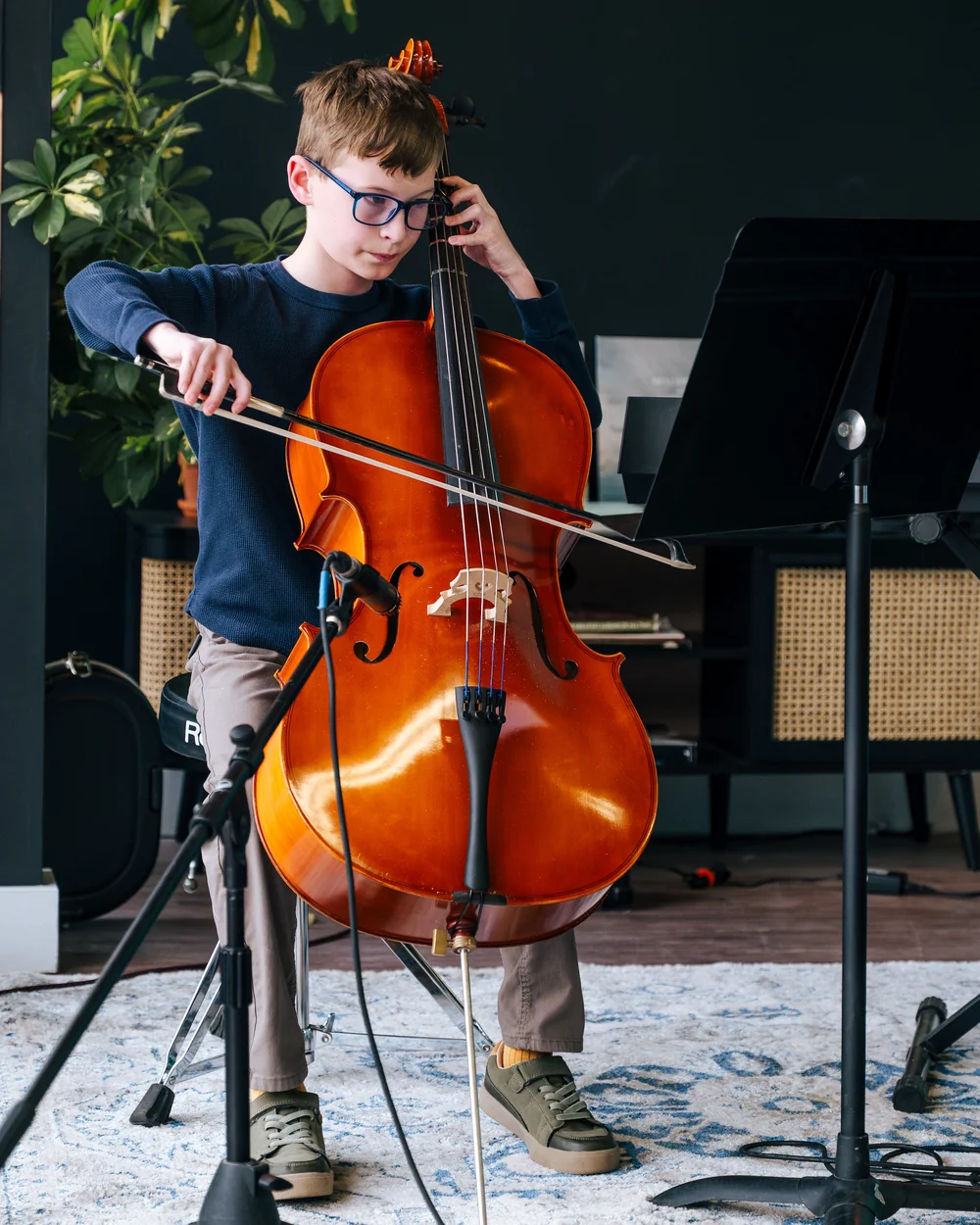
Cello Lessons
Cello lives close to the body.
Cello lessons in Edmonton for kids, adults, and returning players. The cello is one of the few instruments that vibrates directly into the player. It's held against the chest, played from a seat, and resonates at frequencies the body feels before the ear catches them. Lessons here build that physical relationship from the first session.
Who cello tends to fit.
Cello at Resonate runs across ages. Kids start as young as the half-size and quarter-size instruments allow. Adults come in for the first time in their lives, or come back to it after years away. The classical literature is deep, but cello shows up across a lot of music. Pop arrangements, indie folk, film scores, jazz combos, singer-songwriter records. The path students take depends on what they want to play and where they want to end up.
Pricing snapshot
Weekly membership includes make-up flexibility with at least one week's notice and one complimentary recording studio hour every three months.
Not sure which fits? See how membership and drop-ins compare.
Cello lessons here are taught by a gospel and jazz musician.
Jack Lumayor teaches cello, piano, guitar, bass, ukulele, voice, and theory at Resonate. He's a gospel and jazz musician with a BFA in music and over a decade of teaching, both in private lessons and Edmonton schools. Gospel, jazz, R&B, soul, and bossa nova are the music he plays, and lessons here often draw on the connections between cello and those styles.
For Jack, music is a conversation. Technique is what gives a player the language to say something in it. Lessons start by checking in on what someone has been practicing and how they're hearing it, and the pacing follows from there. Mistakes are part of the path; Jack often points out that being okay with them is what makes the rest of the playing possible.
Click the portrait to hear more about how Jack teaches.
Starting is simple
Tell us a little about who lessons are for and what you have in mind.
You do not need everything figured out first.
Going deeper
If you'd like more before reaching out: common questions, the styles you can study, and what tends to develop in your first months and first year. Each section below is collapsed by default. Tap any heading to read more.
Common cello questions
Real beginner questions. Tap any to read the full answer.
Should I rent or buy a cello?
For a beginner, rent. Renting matters even more on cello than on most string instruments because cellos are significantly more expensive to buy than violins, more cumbersome to store and transport, and (for kids) require multiple size changes before reaching full-size.
Myhre’s Music in Edmonton has a strong rental program for cellos, and we’ve been sending families there for years. The rental is low-commitment, the cello comes properly set up (which matters enormously on cello), and size swaps as your child grows are built into the program. For adults, rental is also often the right starting point, especially for the first year while you find out whether the commitment is going to stick.
Buying makes sense once you’re sure, or for students who have moved past the rental program’s quality ceiling. A solid intermediate cello in the $1500 to $4000 range will serve serious students for years. Below $1000 buys you mostly setup problems that make the instrument harder to play and harder to hear improvement on. Above $5000 starts to move into hand-built territory where the differences become subtle.
What size cello do I need?
Cellos come in fractional sizes for children and full size (4/4) for older kids and adults. Rough guidelines:
- Ages 4 to 5: 1/16 or 1/10
- Ages 5 to 7: 1/8 or 1/4
- Ages 7 to 9: 1/2
- Ages 9 to 11: 3/4
- Ages 12 and up: 4/4 (full size)
- Smaller-framed adults: 7/8 is sometimes more comfortable
Sizing is about arm length and height, not just age. The standard test is to sit with the cello between your knees with the endpin extended. The C-string peg (the top one) should be about level with your left ear, and your bow arm should be able to draw across all four strings without straining the shoulder. A teacher can size a student on the spot before the first lesson, which is one more reason starting with rental is so practical.
Cello vs violin: which is right for me?
Both are great instruments with deep traditions, and the choice usually comes down to physical preference, musical taste, and what you actually want to play.
Cello is held seated, between the knees, with the bow drawn horizontally across the strings. The sound is lower-pitched and resonant, closer to a singing voice or to a cello section in a film score. Cello is physically demanding in a different way than violin: you sit, you support the instrument with your knees and chest, the left-hand reaches are longer (because the strings are longer), and the bow weight matters more. Cello is less common as a starting instrument than violin, which means smaller class options at the kid level but also less competition for serious students later.
Violin is held under the chin, played standing or seated, with the bow drawn at a more vertical angle. The sound is higher-pitched and quicker to articulate. Violin is significantly more portable than cello and has more starting-age flexibility (the smallest violins fit younger kids than the smallest cellos). The classical repertoire for violin is larger, but cello has its own rich tradition and is increasingly used in contemporary indie and pop arrangements.
For most students, the right instrument is the one whose sound pulls them in. A cello you love practicing on teaches more than a violin you don’t.
What’s a good age to start cello lessons?
Cello is one of the earlier string instruments students can begin, with the Suzuki tradition successfully starting kids as young as 4 or 5 on appropriately-sized fractional cellos. Most cello students start somewhere between ages 5 and 8. Earlier starts work when the child has the attention span for a short structured lesson and a parent who can help carry the practice between lessons.
The physical considerations are different from violin: the cello is between the knees rather than under the chin, the left-hand reaches are longer, and the bow weight matters more. Some kids find the seated, between-the-knees posture easier than the under-chin balance of violin. Others find the reverse. A teacher can usually tell within the first lesson whether the size and posture are right.
For kids under 4 who love music but aren’t quite ready for a private cello lesson, our Tunes & Tots program (ages 2 to 3) and Junior Jammers (ages 4 to 5) build pitch, rhythm, and musical foundation in a group setting.
Adults often ask whether they’re starting too late. They aren’t. Adults bring more attention span and clearer goals than young kids, though the early period of cello is genuinely harder for adults than for kids in some ways (the body is less plastic, and reaching down to play a low instrument can take some adjustment). The trade-off is that adults can decide for themselves how much practice time to put in, which is the single biggest variable in how quickly anyone progresses.
Are online cello lessons effective?
In person is generally the better experience, regardless of age. Cello is particularly sensitive to physical setup: left-hand position, bow grip and weight, posture through the seated frame, the angle of the bow across the strings, where the endpin sits on the floor. A teacher in the same room can see and correct these in real time, where a video call compresses the visual cues that matter most.
We keep online lessons available because they genuinely serve students who can’t make it in regularly. That includes students who live out of town and come in occasionally for in-person lessons, recitals, or recording sessions. It also covers the weeks when transportation, weather, or feeling a bit under the weather means an in-person make-up isn’t practical.
Plenty of students use a mix of both formats. The quality difference is real, which is why we treat online as a complement to in person rather than a substitute.
How long until I sound good (and not scratchy)?
The early weeks of cello involve some scratchy sounds, like every bowed string instrument. The good news: cello is slightly more forgiving than violin in this regard. The lower-pitched strings and slower bow speed mean small intonation issues are less obvious than they would be on a higher-pitched instrument. Within the first few weeks of consistent practice, the bow starts to move cleanly across the strings more often than not. By the end of the first month, simple tunes can be played with mostly clean tone. By three months, the scratchy moments are usually the exception rather than the norm.
Sounding “good” in a fuller sense (meaning expressive, in tune, with controlled bow weight and vibrato) takes longer. Practice frequency between lessons is the biggest factor. For students practicing a little most days, real musical sound emerges within the first year. Less consistent students take longer.
What helps the scratchy phase pass faster: a properly set-up instrument (one more reason to rent rather than buy the cheapest available), regular short practice sessions rather than rare long ones, and a teacher who can spot and correct the specific things that cause the scratchy sound in the first place.
Styles you can study at Resonate
Cello lessons here can move across a wide range of musical territory. Tap any style to read more.
Classical
The deepest tradition for cello. Bach (the cello suites are foundational), Brahms, Dvořák, Saint-Saëns, contemporary classical. Reading-based, technique-focused, vibrato-rich. The repertoire where most cellists spend most of their time.
Chamber music and string quartet work
Quartets (with 2 violins and viola), trios, duets. Cello provides the bass voice in chamber settings, and the ability to play in small ensembles opens up significant performance and community opportunities.
Orchestral playing
Symphony and youth orchestra work. Cello is a backbone of any orchestra, and orchestral skills (following a conductor, blending with a section, reading orchestral scores) are their own discipline beyond solo playing.
Contemporary indie and pop
Cello has shown up everywhere in modern music: Sufjan Stevens, Arcade Fire, Iron & Wine, Florence + The Machine, Hozier, and the broader indie-folk tradition. Often paired with recording session work, since cello adds depth to nearly any production.
Crossover and contemporary classical
Yo-Yo Ma’s Goat Rodeo Sessions, Apocalyptica, 2Cellos, Zoë Keating, and the broader world where cello moves between traditions. A natural path for students with a foot in both classical and contemporary.
Theory and reading layered in
For students who want to understand how music works beyond what their hands are doing: scales, key signatures, chord function, ear training, sight-reading. Reading fluency is more essential for cello than for many other instruments because so much of the repertoire is notation-based.
What to expect in your first months and first year
Rough averages. Pace varies based on age, practice consistency, and any prior musical experience.
Your first lesson
How to sit with the cello (between the knees, endpin extended to the right height, chest gently against the back of the instrument), how to hold the bow (which feels strange at first for everyone), posture for both arms, finding open strings, and a first simple bowed exercise on one string. The visible progress varies; what’s actually beginning is the relationship between your body and a notoriously demanding instrument. The scratchy sounds in your first lesson are entirely normal.
Your first month
With consistent practice, which is the single biggest variable in how quickly anyone progresses, most beginners are playing simple tunes on one or two strings by the end of the first month. Bow control starts to improve. The scratchy sound becomes less frequent. Hand position starts to feel less foreign. What’s developing in this period is left-hand finger placement, bow control, the body memory of the seated playing position, and the practice habit. The visible progress can feel slow even when the underlying foundation is building.
Your first three months
By around three months, most students have a small collection of simple tunes they can play through cleanly, growing comfort moving between open strings and fingered notes, and the beginnings of being able to hear when they’re in tune. The scratchy moments are usually the exception by now rather than the norm. Practice begins to feel less like effort. Weekly membership students reach their first complimentary recording studio session around this point, which can become a low-pressure way to capture something they’ve been working on.
Your first year
The difference between students widens here. Those who practice regularly typically have a meaningful catalogue of pieces they enjoy playing, growing comfort across all four strings and into the first few positions, the beginnings of vibrato, and more reliable intonation. Less consistent students may still be building basic comfort, and that’s fine too. Through the year, opportunities to perform in Resonate recitals and to use the included recording studio sessions come up several times for students who want to take them. Cello students often find their way into chamber music or community orchestras during this period because cello is in high demand in those settings.
Beyond the first year
Cello is a lifelong instrument. The teachers here have been playing for decades and still find new things in it. The first year is about getting the foundational pieces down: posture, bow control, basic intonation, comfort with the instrument and the seated playing position. What comes after is leveling up what you can do with those foundations: the repertoire you can take on, the positions you can navigate, the bands or orchestras you can join, the recording sessions you can carry.
Some students build deep classical repertoire. Some join community orchestras and stay there for decades. Some shift into contemporary or session work. Some teach. Many do some combination of these over time.
Most students who stay with cello stay in lessons for years, because the instrument keeps opening up and so does the player. The road forks based on what lights you up, and a good teacher helps you notice which fork is calling.