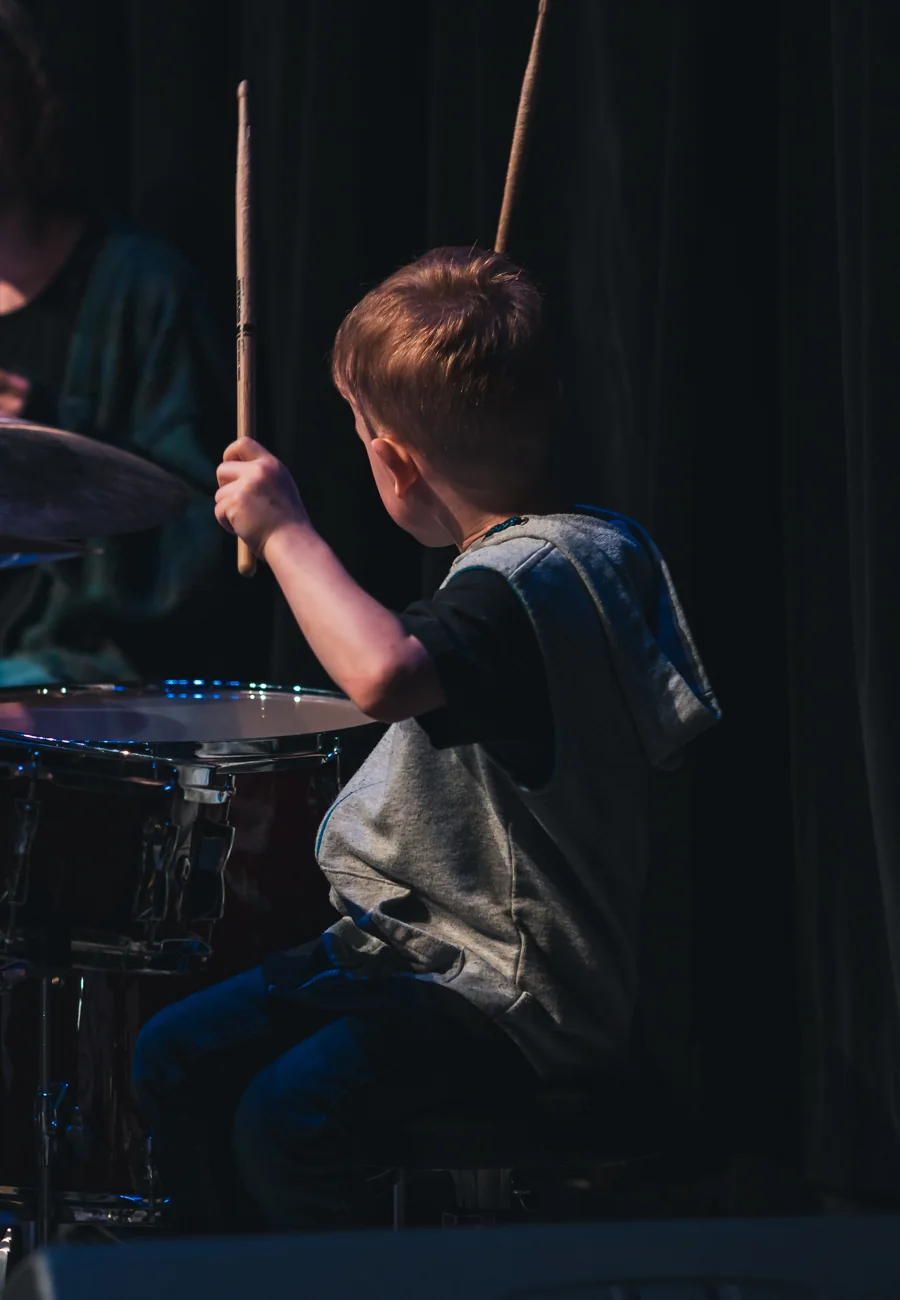
Young drummer performing at a recital with another drummer at Resonate in Edmonton

Drums Lessons

Drums are how music moves.

Time, feel, and the shape of a song all come from the kit. For some, drums become the primary instrument they build everything else around. For others, it is how they end up playing with other people.

Drums are felt before they are heard.

Rhythm starts in the body before it becomes sound. Arms and legs move independently, the kick carries through the floor, and attention holds all of it in time. Drums develop coordination, listening, and a physical sense of how music keeps together.

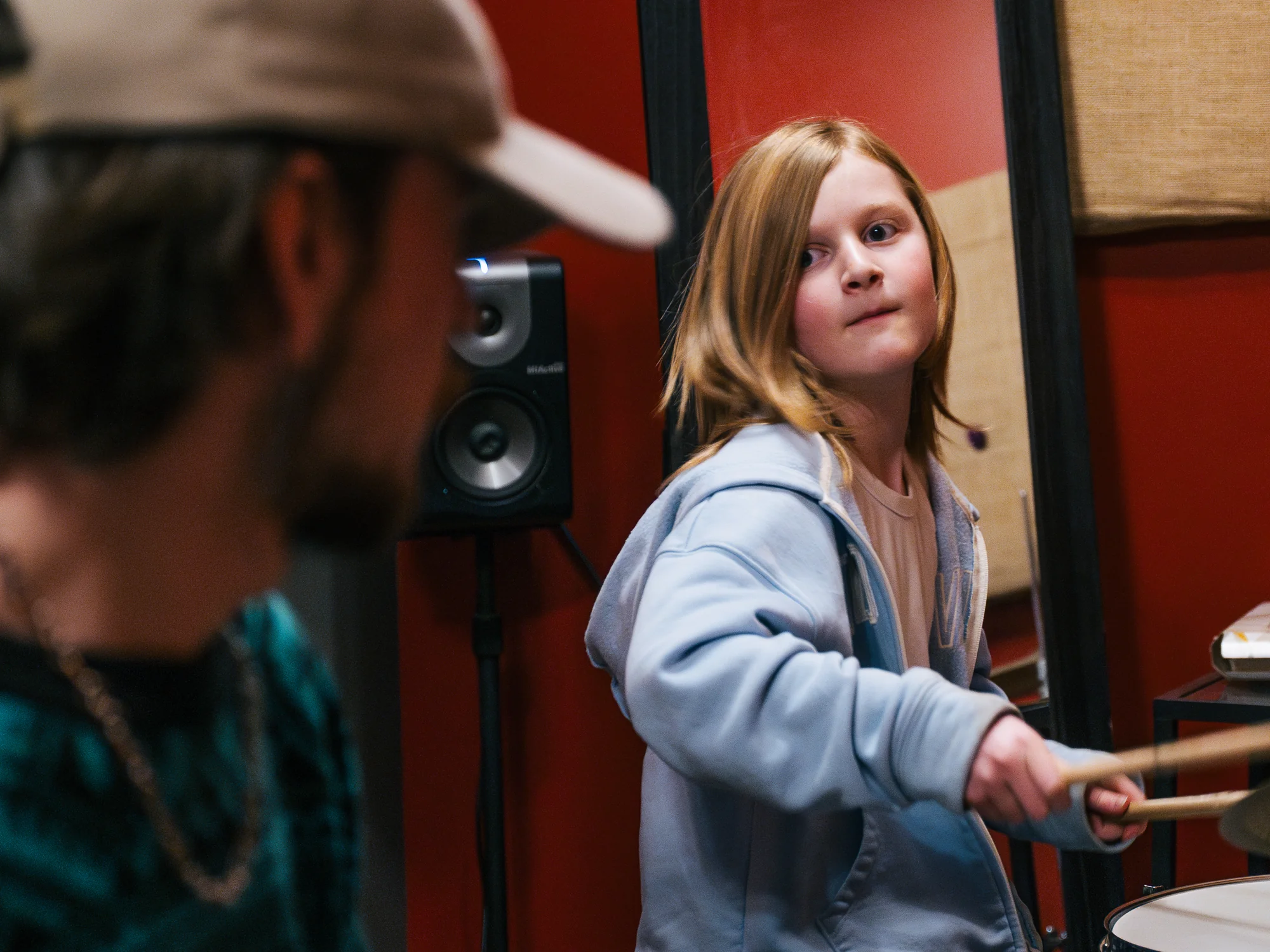
Drum student at the kit with her teacher during a lesson at Resonate in Edmonton

How drum learning tends to unfold here

Drum coordination is largely physical. It tends to settle into the body before it becomes visible in technique.

01

Start with what the body already does

Most drum students arrive already tapping, air-drumming, or moving to songs they love. The body is already finding the beat. Lessons work better when that is the starting point, not something to replace with clean exercises before real drumming begins.

02

Let the feel stay in the room

It is easy for drum practice to drift into pure mechanics. Rudiments, metronome work, and repetition all matter, but they work better when the feel of real music is staying in the room alongside them. Good lessons move between technical detail and the actual groove.

03

Drums live with other musicians

Drums are the most band-dependent instrument in the building. Drum students tend to find themselves playing with other people sooner than most, from sessions with other students to rehearsals to the monthly After Hours Jam. That is not a later stage of learning drums. It is part of learning drums.

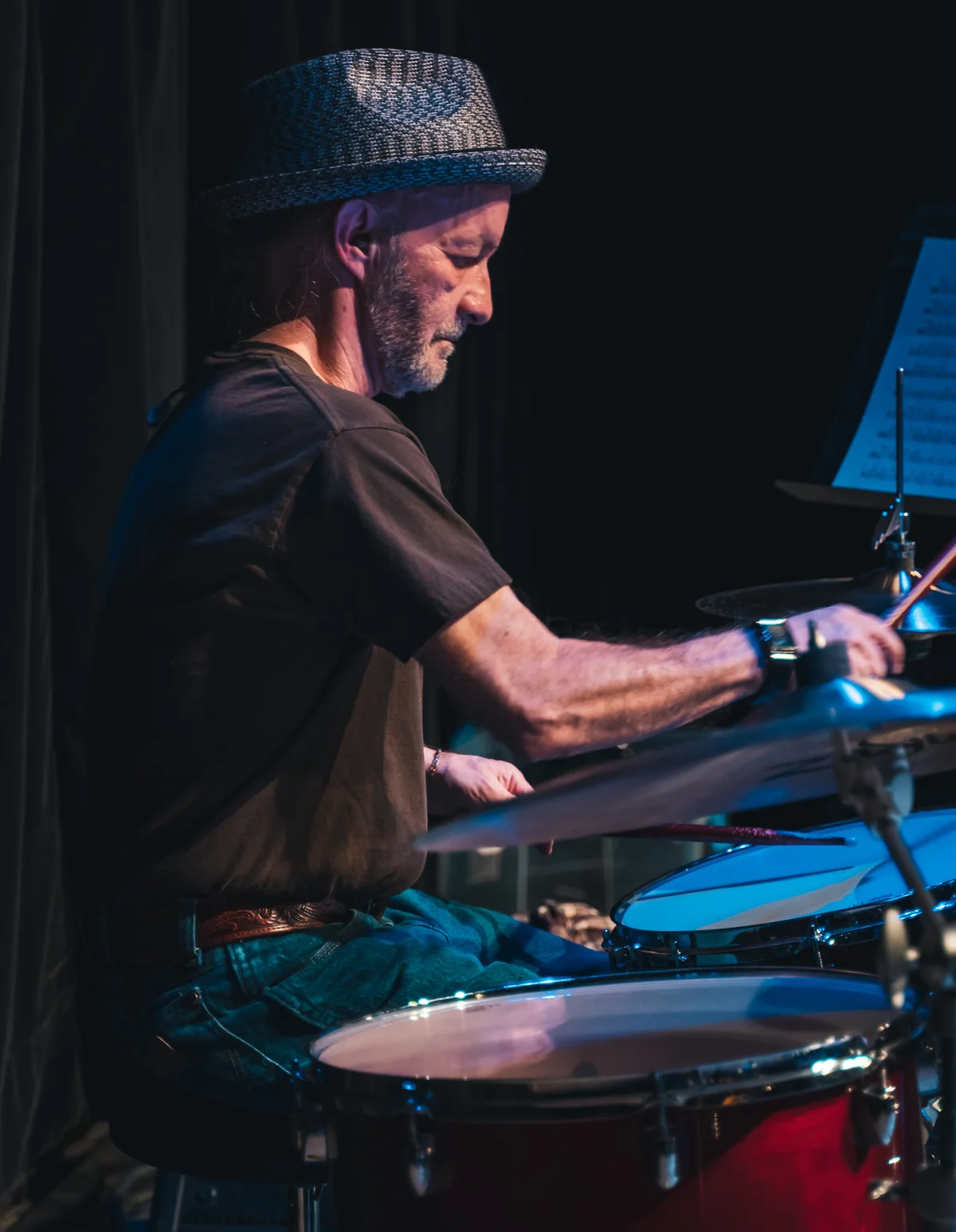
Seasoned drummer performing on stage at Resonate in Edmonton

A good fit often looks like this.

Drums tend to work well for people who already feel rhythm physically. You do not need to have played before. That might mean a kid who is always tapping on things, an adult starting fresh or returning, or someone who already plays another instrument and wants rhythm-section fluency.

People drawn to music production are also a stronger fit than most expect. Rhythm, groove, and timing are foundational to how produced music is built and heard, and having those as physical knowledge rather than just conceptual tends to change the way someone works in a DAW.

Practical lesson options

Private drum lessons are available through weekly membership or as drop-ins.

30 minute private lesson

Often a strong fit for younger beginners, or for people who want a consistent weekly starting point.

60 minute private lesson

A better fit for older students, adults, returning players, or anyone who benefits from more room to settle in and work through ideas.

Weekly membership

The primary lesson structure at Resonate. It includes a reserved weekly lesson time, make-up lesson flexibility, and one complimentary recording studio hour every three months.

Drop-ins

A flexible option for students who do not want a fixed weekly time. These are single lessons booked individually based on teacher and schedule availability.

Pricing snapshot

01
30 minute lesson – drop-in
$40
02
30 minute lesson – weekly membership Lessons on Mondays are $135/mo to account for long weekends
$145/mo
03
60 minute lesson – drop-in
$75
04
60 minute lesson – weekly membership Lessons on Mondays are $265/mo to account for long weekends
$285/mo

Weekly membership includes make-up flexibility with at least one week's notice and one complimentary recording studio hour every three months. Lesson rooms have full drum kits, so you do not need to own one to start.

Lessons here are taught by a gigging drummer.

Tristen Tiefenbach is the drum teacher at Resonate. He plays drums in two active Edmonton bands, Monks On Call and Gratuitous, and writes, records, and gigs with both. Monks On Call's most recent album was recorded at the Resonate studio. His drumming has put him on stages across Canada, including opening for Calpurnia at MacEwan Hall and a first-place set at the Starlite Room Battle of the Bands. He also does clinic work with middle-school and youth summer programs.

Students who come in for drums find a teacher who treats trying as the work itself. Tristen was terrified of teaching at first, until years of gigging with different players showed him that you don't need the perfect words to help someone find what they're working on. The thing he says he passes on most often is that nothing is perfect and never will be. Perfection is the inspiration, not the aspiration.

Click the portrait to hear more about how Tristen teaches.

Starting is simple

Tell us a little about who lessons are for and what you have in mind.
You do not need everything figured out first.

Start Here

Going deeper

If you'd like more before reaching out: common questions, the styles you can study, and what tends to develop in your first months and first year. Each section below is collapsed by default. Tap any heading to read more.

Common drum questions

Real beginner questions. Tap any to read the full answer.

Will drum practice be too loud for my home or neighbours?

This is the first question almost every drum parent and adult student asks, and there are real answers. For home practice, drummers have three useful options.

A practice pad (a rubber or silicone disc) is nearly silent and is genuinely useful for working on grip, sticking, rudiments, and many of the things you’d be working on between lessons anyway. An electronic kit with headphones is also nearly silent to the outside world and gives you a full kit to play. A dampened acoustic kit (low-volume cymbals with cutouts, and mesh or low-volume drum heads) cuts the volume of a regular acoustic kit by roughly 80%, which puts it in the range of a vacuum cleaner instead of a rock concert. Many home drummers use some combination.

Our lesson rooms at Resonate use dampened acoustic kits for exactly these reasons. Students get the actual feel of an acoustic instrument and learn things like tuning and stick-to-head response, but without the volume that would wreck the rooms around them. That same setup works in a home if you go acoustic.

Electronic kit or acoustic kit at home?

Both are legitimate. The choice depends on your space, your neighbours, your budget, and what you want to play.

An electronic kit (Roland, Yamaha, Alesis, and others make solid options across price ranges) is quiet, compact, and consistent. The pads always feel the same, you can play any time of day through headphones, and many include built-in lessons and play-along features. The trade-off is feel: even good electronic kits don’t quite match the rebound and dynamic response of a real drumhead, and cymbal hits can feel less satisfying.

An acoustic kit feels and responds the way drums actually do. Tuning matters, stick choice matters, and the kit responds to how you hit it in ways no electronic kit fully captures. The trade-off is volume, unless you take it down with mesh heads and low-volume cymbals, which puts it in the range of a quiet conversation. A dampened acoustic kit at home can be a real best-of-both setup.

Many students never own an acoustic kit and have full musical lives on electronic. Many start electronic and add acoustic later. Whichever direction you go, what matters most is having something at home to practice on.

What do I need at home for practice?

Something. Not necessarily a full kit on day one, but the time between lessons doesn’t compound without something to practice on. A practice pad and a pair of sticks ($30 to $50 total) is enough to start working on grip, sticking, and the basic rudiments. Many students start there and add a full kit (electronic, acoustic, or dampened acoustic) once lessons are clearly going to stick. Our lesson rooms have full kits, so you don’t need to own one to begin, but you do need somewhere to put in the reps between lessons.

What’s a good age to start drum lessons?

Most students start private drum lessons between ages 6 and 8. The main consideration with drums is physical. A young child needs to be able to comfortably reach the pedals (bass drum, hi-hat) without straining, hold the sticks with enough control to move them where they want, and sustain attention long enough to work through a pattern. For kids who are physically smaller, a junior-sized acoustic kit or an electronic kit with adjustable height makes early lessons more accessible.

Some kids are ready at 5 if they have the coordination and the interest. Others do better waiting until 7 or 8. The teacher can usually tell within the first lesson whether a kit is the right size or whether to start with practice pad work until the body catches up.

For kids under 6 who love rhythm but aren’t quite ready for a private lesson, our Tunes & Tots program (ages 2 to 3) and Junior Jammers (ages 4 to 5) build rhythm and musical foundation in a group setting.

Adults often ask whether they’re starting too late. They aren’t. Drums reward adult students who bring focus and physical patience to the practice.

Are online drum lessons effective?

In person is generally the better experience, regardless of age. Drums are particularly hands-on: stick grip, posture at the kit, foot technique on the pedals, and the way the whole body moves through a beat are all easier for a teacher to see and correct in the same room.

We keep online lessons available because they genuinely serve students who can’t make it in regularly. That includes students who live out of town and come in occasionally for in-person lessons, recitals, or recording sessions. It also covers the weeks when transportation, weather, or feeling a bit under the weather means an in-person make-up isn’t practical.

Plenty of students use a mix of both formats. The quality difference is real, and we noticed it directly during the COVID period when everything was online. That’s part of why we treat online as a complement to in person rather than a substitute.

How long until I can play along to a song?

How quickly varies between students, and practice frequency between lessons is the biggest factor. For an engaged beginner practicing a little most days, a basic rock or pop beat (kick, snare, hi-hat) is usually playable within the first few weeks, and a complete song built around that beat is often within reach by the end of the first month. For students who practice less consistently, it can take longer.

What “playing along” means varies. Holding a steady beat through the song is one threshold. Adding the fills and transitions is another. Locking in with the recording so it sounds like one performance rather than two is a third. Most students cross the first threshold in their first month or two of consistent practice.

Styles you can study at Resonate

Drum lessons here can move across a wide range of musical territory. Tap any style to read more.

Rock and pop

The most common starting point. Backbeat, basic and intermediate fills, song-form drumming, and the patterns behind the music most students arrive wanting to play. Lessons build around the songs that pulled you toward drums in the first place, and the underlying patterns transfer easily into nearly every other style.

Funk and groove

Sixteenth-note hi-hat patterns, ghost notes, the conversation between kick and snare, and the kind of deep pocket that makes a song move. From James Brown and Sly to contemporary funk, soul, and R&B. Useful as a primary style for students drawn to feel-heavy music, and as a foundation that sharpens everything else.

Jazz

A full tradition with its own vocabulary: swing feel, ride cymbal patterns, comping with the snare and bass drum, brush technique, and the practice of listening hard to other players in real time. Builds independence between the limbs in ways most other styles don’t demand.

Latin and Afro-Cuban

Bossa, samba, salsa, songo, mambo, and the rhythmic vocabulary that runs through nearly all popular music. The clave is the foundation, and once it’s under the hands, a lot of contemporary music starts to make more sense. Often paired with funk and jazz study.

Metal and heavier styles

Double-kick patterns, the technical demands of faster tempos, the stamina the music requires, and the foundation work that has to come first to play any of it cleanly. A real path for students drawn to heavier music, and demanding enough that the work transfers into every other style they touch.

Technique and rudiments layered in

Practice pad work, the essential rudiments, hand control, foot technique, and metronome work. Rarely a primary style on its own but underlies everything else a drummer plays. Especially valuable for students wanting to develop facility, speed, and dynamic control across styles.

What to expect in your first months and first year

Rough averages. Pace varies based on age, practice consistency, and any prior musical experience.

Your first lesson

Most first lessons cover how to hold the sticks (matched grip is typical for beginners), how to sit at the kit, basic exercises on the snare or practice pad, and either a first simple beat or a first rudiment depending on what your teacher starts you on. A bit of take-home practice to start the muscle memory. The visible progress varies; what’s actually beginning is the coordination between hands and feet, which takes time to settle.

Your first month

With consistent practice, which is the single biggest variable in how quickly anyone progresses, most beginners have a basic rock beat (kick, snare, hi-hat) under the hands by the end of the first month and can hold it through a short song with growing confidence. Coordination between hands and feet is the central work. What’s developing is the ability for your limbs to do different things at the same time, which feels impossible at first and gradually starts to feel natural. The visible progress can feel slow even when the underlying foundation is building.

Your first three months

By around three months, most students have a small collection of beats and the first real fills between sections of a song, growing comfort moving around the kit, and the beginnings of being able to play along with full songs. Practice begins to feel less like effort. Weekly membership students reach their first complimentary recording studio session around this point, which can become a low-pressure way to capture something they’ve been working on.

Your first year

The difference between students widens here. Those who practice regularly typically have a meaningful catalogue of beats and fills, the beginnings of independence on the limbs (the ability to play different patterns simultaneously on hands and feet), and the comfort to play through full songs reliably. Less consistent students may still be building basic limb independence, and that’s fine too. Through the year, opportunities to perform in Resonate recitals and to use the included recording studio sessions come up several times for students who want to take them. Drummers often end up in band situations earlier than students of other instruments because every band needs one. The honest answer to “where will I be after a year” is that practice frequency between lessons matters more than almost any other factor.

Beyond the first year

Drums is a lifelong instrument. The teachers here have been playing for decades and still find new things in it. The first year is about getting the foundational pieces down: stick control, basic coordination between hands and feet, comfort behind the kit, the rhythm of practice itself. What comes after is leveling up what you can do with those foundations: the styles you can play, the songs you can join in on, the bands you can keep up with, the recording sessions you can take on, the rooms you can fill.

Some students build deep facility across many styles. Some focus on one tradition and go deep. Some join bands. Some shift into producing or recording. Some teach. Many do some combination of these over time.

Most students who stay with drums stay in lessons for years, because there is always another layer to add: another style, more independence, more refined dynamics, more nuanced feel. The road forks based on what lights you up, and a good teacher helps you notice which fork is calling.