01
Start with what is already present
Some students arrive curious and completely new. Others already know a few songs, patterns, or chords. Lessons work better when they begin from what is actually there.

Piano Lessons
Piano lessons in Edmonton for beginners, returning players, and adults. Rhythm, melody, and harmony come together in one place, where they become easier to understand through direct physical experience. For some people, that is why piano becomes a strong first instrument. For others, it is a way back in, or a deeper way of understanding the music they are already hearing, singing, writing, or making.
Harmony takes shape. Patterns repeat. Rhythm, coordination, listening, memory, and expression connect through the hands. Piano builds attention, control, awareness, and a stronger sense of how music works.
Progress at piano tends to be cumulative in ways that aren't always visible from one lesson to the next.
Some students arrive curious and completely new. Others already know a few songs, patterns, or chords. Lessons work better when they begin from what is actually there.
It is easy for piano to become overly mechanical. Good lessons move between detail and expression, keeping the broader musical picture intact.
At Resonate, piano lessons open outward as students grow. They can move into performance, collaboration, songwriting, accompaniment, and recording. That broader environment connects piano to real participation in music.
Piano tends to work especially well for people who want a clearer relationship with music.
That might mean starting for the first time, returning after a long break, building a stronger foundation, or getting closer to the music you are already singing, writing, producing, or listening to.
Piano teachers at Resonate are active musicians and artists whose own musical lives include helping other people grow into music more fully. One-to-one guidance from a trained professional is rare, and it gives students something genuinely personal and responsive.
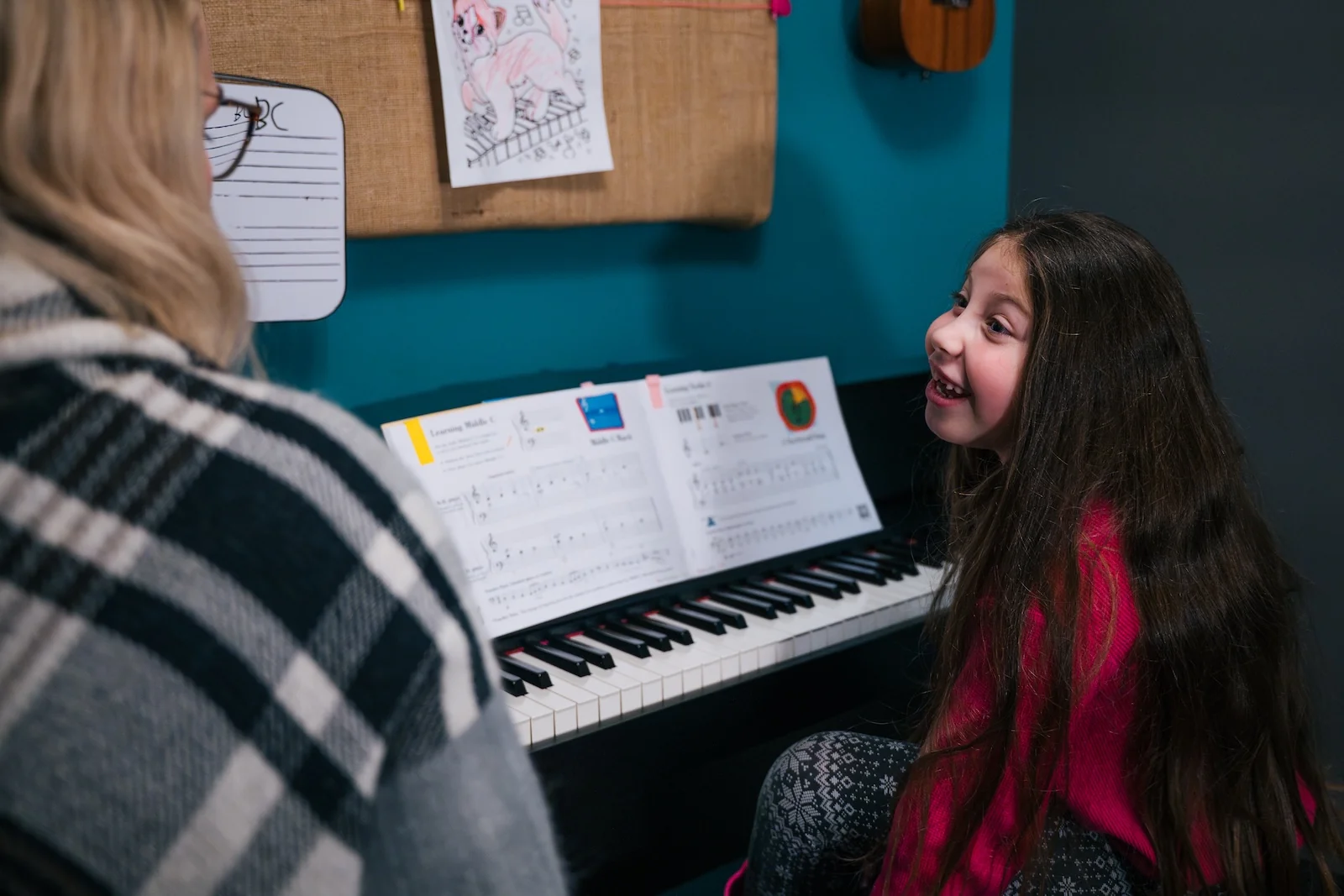
In one-to-one lessons, guidance can adjust in real time. A teacher can notice what is clicking, where someone is getting stuck, and how to shape the next steps around the actual person in the room. That kind of attention helps students feel supported and connected to what they are learning.
Click a portrait to hear more about how they teach.
Tell us a little about who lessons are for and what you have in mind.
You do not need everything figured out first.
If you'd like more before reaching out: common questions, the styles you can study, and what tends to develop in your first months and first year. Each section below is collapsed by default. Tap any heading to read more.
Real beginner questions. Tap any to read the full answer.
Most students start on a digital instrument and a lot stay there. A basic digital keyboard is enough for the first lessons. A digital piano with weighted keys feels remarkably close to an acoustic and adds things an acoustic can’t: headphone practice, a built-in metronome, transposition, and a few hundred other sounds. Roland, Yamaha, and Kawai all make digital pianos worth looking at. An acoustic piano (upright or grand) is its own kind of instrument, with a fuller tone, more nuance in the touch, and a presence in the room nothing else quite matches.
None of these is the only right choice. What matters most is having something at home for daily practice. A piano you only see during your lesson won’t get the repetition the instrument needs.
The target is 88 weighted keys, regardless of whether you go digital or acoustic. Weighted keys (sometimes called hammer-action) respond the way an acoustic does, so the technique you build at home transfers to any piano you sit down at. Unweighted keys feel different, and reaching for a weighted instrument later can feel awkward.
Eighty-eight keys gives you access to the entire piano repertoire as the music gets more advanced. For early lessons, anything from 61 keys up will get a student started, but plan to upgrade before the music outgrows what you have. A reasonable starting point for a digital piano with weighted action is roughly the $400 to $1000 range; higher-end models run further up. Used acoustic uprights are widely available in Edmonton if you find yourself fully committed and ready for that direction.
Both paths are available, and many students do some of each. Sheet music reading is the traditional path and stays useful for classical music, written compositions, and anyone who eventually plays alongside other written music. Chord-chart playing and learning by ear cover contemporary pop, songwriting, accompanying a singer, and most of what comes up in a band setting.
Your teacher will adjust based on what you actually want to play. A student aiming at Chopin needs more reading than a student aiming to play Norah Jones from a chord chart. Many students who start chord-based later add reading because they want access to more music. What you learn depends on what you want to do with the instrument.
Most students start private piano lessons between ages 6 and 8. Piano is one of the more forgiving instruments to start young because there’s no instrument sizing and no fatigue from holding it. Some kids do well starting at 5, and a small number of motivated 4-year-olds (often the ones already drawn to the piano at home) can get going on a more limited basis.
For kids under 6 who are interested in music but not quite ready for a private lesson, our Tunes & Tots program (ages 2 to 3) and Junior Jammers (ages 4 to 5) build the underlying musical foundation in a group setting. Many of those kids transition smoothly into private piano lessons at 6.
Adults often ask whether they’re starting too late. They aren’t. Adults bring more attention span, clearer goals, and a stronger sense of what music they actually want to play, which usually translates into faster progress on the music that matters to them.
In person is generally the better experience, regardless of age. Hand position, posture, finger curl, and the way the sound fills the room are all easier to address in the same space.
We keep online lessons available because they genuinely serve students who can’t make it in regularly. That includes students who live out of town and come in occasionally for in-person lessons, recitals, or recording sessions. It also covers the weeks when transportation, weather, or feeling a bit under the weather means an in-person make-up isn’t practical.
Plenty of students use a mix of both formats. The quality difference is real, which is why we treat online as a complement to in person rather than a substitute.
How quickly varies between students, and practice frequency between lessons is the biggest factor. For an engaged beginner practicing a little most days, a short piece with both hands is often within reach in the first month. For students who practice less consistently, it can take longer.
What “playing a song” means varies. Getting through a piece with both hands at a slow tempo is one threshold. Playing it cleanly and at speed is another. Playing it with expression is a third. Most students cross the first threshold in their first month or two of consistent practice.
Piano lessons here can move across a wide range of musical territory. Tap any style to read more.
The deepest tradition for piano. Bach, Beethoven, Chopin, Debussy, and the technique that comes with playing those composers. Classical lessons build reading fluency, finger independence, dynamic control, and a vocabulary that carries over to almost any other style. Useful as a primary path for students who want a rigorous foundation, and as a base layer for anyone planning to play seriously across genres.
The most common starting point for adult beginners and many teens. Songs from the radio or playlists, played as chord progressions with melody on top or as full piano arrangements. Adele, Coldplay, Billie Eilish, Norah Jones, Ben Folds, and the broader contemporary songwriting tradition. Often combined with voice in lessons for students who want to sing while they play.
For students who want to play freely rather than only from a page. Chord voicings, ii-V-I progressions, blues form, walking bass lines, and the practice of improvising over changes. A natural fit for adults coming back to piano with more developed musical taste, and for students whose interest in music includes wanting to make some of it up on the spot.
For students writing their own songs or wanting to. Chord choice, voice leading, finding a melody, structuring verses and choruses, working out arrangements at the keyboard. Often paired with voice in lessons, since most songwriters end up singing what they write. The piano makes the underlying harmony unusually clear, which is why so many songwriters work at it even when they don’t perform on it.
Piano is the ideal instrument for understanding how music actually works. Every note is laid out in front of you, scales and chords have a visual shape, and the relationships between notes are easier to see than on most other instruments. Theory and ear training don’t have to be a separate study; they tend to layer naturally into whatever music you’re working on. Especially valuable for students moving toward songwriting, arranging, or playing with other musicians.
Playing with singers, in bands, or supporting other instrumentalists. Piano fills more space than almost any other instrument, which is why a good pianist is welcome in nearly every group. Comping (playing chords behind a soloist), reading lead sheets, transposing on the fly, and locking in with a rhythm section. Common at Resonate because the broader environment (recitals, jam nights, recording sessions, the After Hours Jam) gives students places to actually play with other people.
Rough averages. Pace varies based on age, practice consistency, and any prior musical experience.
Most first lessons cover how to sit at the piano, hand position, finding C and the basic geography of the keyboard, and either a first 5-finger pattern, a first chord, or a first short piece (depending on what your teacher starts you on). A bit of take-home practice gets you started. The visible progress varies; what’s actually beginning is the muscle memory and the rhythm of spending time at the piano between lessons. The underlying foundation has started either way.
With consistent practice, which is the single biggest variable in how quickly anyone progresses, most beginners are working on their first short piece by the end of the first month. Often something with a simple melody in one hand and basic accompaniment in the other, or hands together on something straightforward. Some students get there sooner. Others take longer, especially if practice between lessons is irregular. What’s developing in this period is finger independence, the muscle memory of where the keys are without looking, and the practice habit itself. Early progress tends to be visible. Pressing the right key makes the right sound, so students hear themselves making music almost right away.
By around three months, most students have a small collection of pieces or exercises they can play through, though the size of that collection depends on practice habits and how naturally things click. Hand independence starts to settle. This is also where the early progress curve tends to flatten. The first three months forgive irregular practice. From here on, practice between lessons starts to decide the curve. For many students this is when sitting down at the piano between lessons starts to happen on its own. Weekly membership students reach their first complimentary recording studio session around this point, which can become a low-pressure way to capture something they’ve been working on.
The difference between students widens here. Those who practice regularly typically have a meaningful repertoire of pieces they enjoy playing, growing comfort moving across the keyboard without looking, and the beginnings of being able to learn new music either by reading or from a chord chart. Less consistent students may still be building basic fluency, and that’s fine too. Through the year, opportunities to perform in Resonate recitals and to use the included recording studio sessions come up several times for students who want to take them. The honest answer to “where will I be after a year” is that practice frequency between lessons matters more than almost any other factor. The gap between students who play a little most days and students who play once a week is significant.
Piano is a lifelong instrument. The teachers here have been playing for decades and still find new things in it. The first year is about getting the foundational pieces down. What comes after is leveling up what you can do with those foundations: the music you can play, the songs you can write, the players you can keep up with, the recording sessions you can take on, the performances you can pull off.
Piano also tends to make the rest of music easier to see. The treble and bass clefs sit together on the page. The notes lay out left to right by pitch. Chords, scales, and harmony become visible on the keyboard. A lot of songwriters, producers, and multi-instrumentalists keep piano around for this reason long after they stop calling themselves piano players.
Some students build deep classical repertoire. Some shift into songwriting, accompaniment, or jazz. Some go into theory and improvisation. Some join bands. Some teach. Many do some combination of these over time.
Most students who stay with piano stay in lessons for years, because the instrument keeps opening up and so does the player. The road forks based on what lights you up, and a good teacher helps you notice which fork is calling.